
By Maria Athanasiou MD MFOM MBA
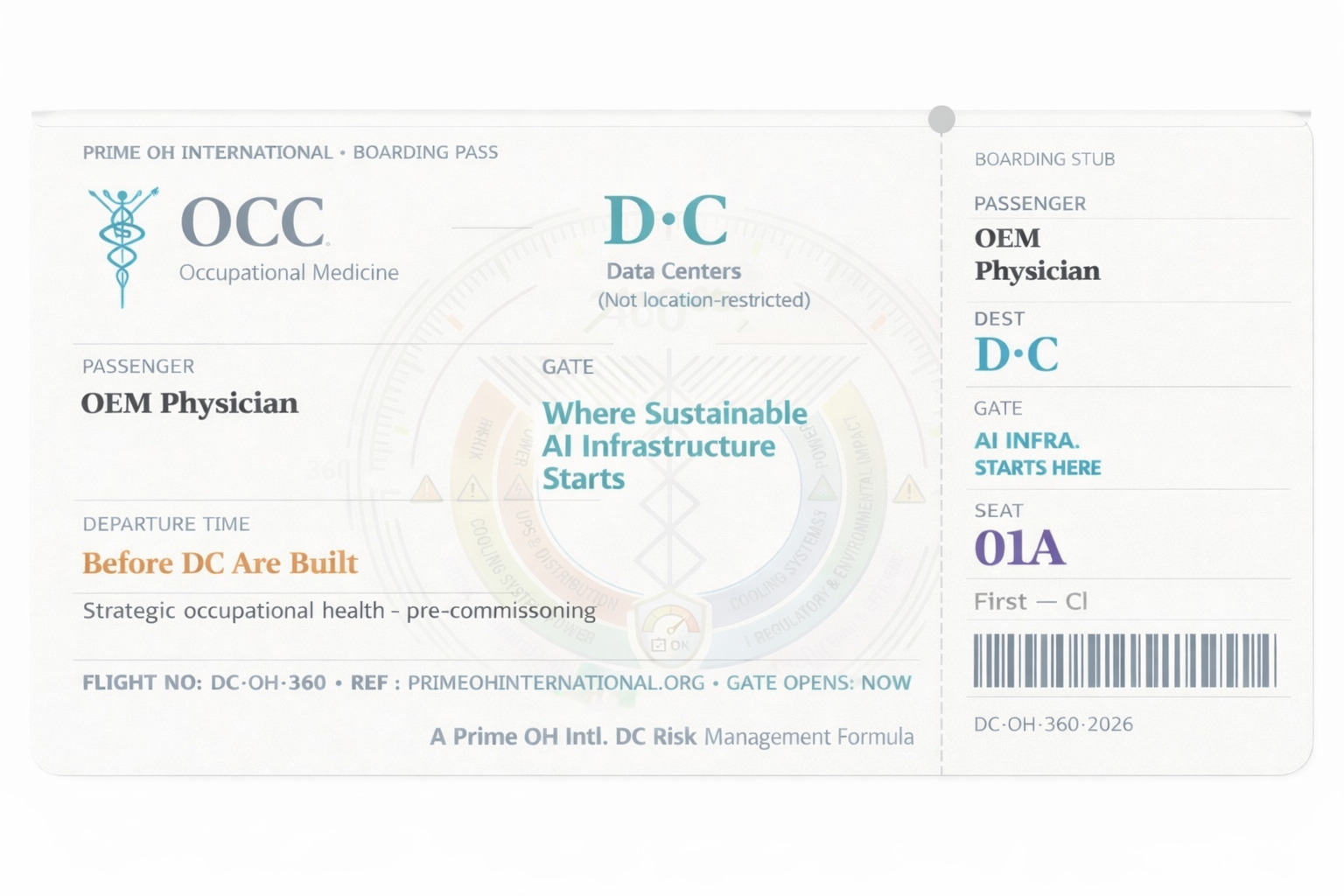
Travelling day today, and what a destination and new venture. Next stop: Reykjavik.

What started as a consulting project in 2018 evolved into a complete breakthrough in AI Infrastructure Occupational & Environmental Health Risk Management—what was later named the 360° Roadmap.

Understanding the vast operational shift from MegaWatts to GigaWatts, and ultimately to TerraWatts, made me realise the catastrophic human and commercial impact of a system failure. Let alone if such a failure led to a arc flash or a full-scale blast.

I knew from the very first moment who could explain the technical specifications, context, consequences, and prerequisites of this high-voltage reality to me. A person, an electrical engineer and accredited safety officer, who didn't build his legacy on purely academic credentials, but on raw, high-stakes execution. Rising from a technical school diploma to a university degree in Electrical Engineering, he has put his signature as the lead engineer on giant projects—bridges, tunnels, hydroelectric units, nuclear facilities, and heavy industrial plants on national and international scales. That person is no one else than my Dad.

During the process, as my involvement in the first major data center project unfolded, he became my ultimate go-to person for complex electrical safety queries. While my corporate safety counterparts were addressing my small, yet carefully architected questions, the underlying framework was solidifying. The outcome was phenomenal: a heavily optimised health & safety roadmap that remains under constant review for continuous improvement.

Currently, almost every corporate ally describes Prime OH International's risk management tool as a breakthrough start-up, a framework supporting and laying in the foundations of sustainable AI Infrastructure. While I am deeply thankful for the compliment, I always remind them: “There has been a definitive start; but the ultimate impact is realised once the 360° Occupational & Environmental Health Risk Management framework is fully implemented. This is the way up...”
The Risk Management Architecture: From Groundbreaking to System Failure
To design a resilient digital world, we must map the health, occupational, and environmental risks across the five lifecycle phases of a hyperscale data center: Settling, Function, Maintenance, and System Outage, Environmental Component.
The Settling & Design Phase:
1.The Baseline of Risk
Risk management begins before the concrete is poured. Environmental health profiling at this stage must assess localised ecological impacts, geological baseline stability, and early supply-chain logistics. Failing to integrate occupational & environmental health standards into the initial architectural blueprint creates "legacy hazards"—such as poor acoustic baffling or inadequate physical egress points—that permanently endanger operational staff once the site goes live.
2. The Function Phase: The Invisible Hazards of High-Density Computing
When a data center is fully functioning, it is a living, high-density energy ecosystem characterised by invisible, chronic stressors:

The Acoustic Burden: Continuous, high-frequency noise from thousands of server fans and liquid cooling pumps induces cognitive fatigue, hidden hearing loss, and elevated cortisol levels among onsite engineers.

Ergonomic and Psychosocial Stress: The high-velocity pressure of maintaining 99.999% uptime creates an intense cognitive load. Staff manage complex digital asset mapping under severe time constraints, accelerating burnout and human-factor operational errors.
3. The Maintenance Phase: Interventions in Critical Environments
Maintenance demands direct human interaction with complex mechanical, electrical, and plumbing (MEP) systems. Technicians face acute risks from chemical exposures linked to specialised dielectric fluids, water-treatment refrigerants, and heavy battery storage units. Working in tightly confined server corridors with fluctuating thermal environments requires highly tailored "fit-for-purpose" medical monitoring and strict procedural controls.
4. Failure, Outage, and the Worst-Case Scenario: The Arc Flash & Blast
When a system suffers a catastrophic failure, the environment transforms instantly. The absolute worst-case scenario in a hyper-scale facility is a catastrophic power surge leading to an arc flash or a physical blast.

The consequences are devastating: blast overpressure capable of tearing lung tissue and shattering eardrums, thermal radiation exceeding $19,000^\circ\text{C}$ ($35,000^\circ\text{F}$) that vaporizes metal components instantly, and toxic gas release from burning polymers and lithium-ion storage cells. For personnel in the immediate vicinity, this means severe airway compromise, catastrophic trauma, and neurovascular shock.

For the organisation, it means total operational paralysis and severe legal liability.
5. Addressing the Environmental Debt: Protecting Our Home, Workers, and Communities
Hyperscale data centers do not exist in a vacuum; they leave an undeniable physical and ecological footprint on the planet we call home. As computation demands skyrocket, we must confront the compounding "Environmental Debt" generated by these facilities:

Soil and Water Contamination: The concentrated infrastructure of a data center introduces severe environmental liabilities, notably the risk of heavy metals (such as lead, cadmium, and chromium from electronic components and circuit boards) leaching into the local soil during improper waste handling. Furthermore, accidental runoffs of toxic dielectric fluids, chemical refrigerants, and industrial water-treatment biocide agents present an immediate threat to local water tables and aquatic ecosystems, demanding rigorous, preemptive environmental containment protocols.
The Community & Resource Burden: Massive water consumption for evaporative cooling systems and localized grid strain often pit data centers against the very communities that host them, causing resource scarcity and heightening community psychosocial stress.
The Worker & Environmental Ecosystem: Onsite personnel and local ecosystems face long-term exposure to localized heat islands, heavy particulate matter from backup diesel generators during testing, and the complex recycling lifecycle of toxic e-waste and lithium batteries.
True sustainability means our 360° Roadmap must look beyond the perimeter fence. By proactively managing this environmental debt through circular resource governance, emission mitigation, and transparent community health metrics, we ensure that technological advancement does not come at the expense of human or ecological well-being.
The Momentum of Trust: Building a Sustainable Digital World
The trust we have earned from C-suite stakeholders, sovereign entities, and tech giants across continents has transformed our vision into a self-sustaining momentum that only accelerates. We are no longer just advising; we are deploying and executing  a standardised global shield for the world's most critical infrastructure.

The weight of this duty does not burden us—it fuels us. It makes us entirely more enthusiastic and determined to serve as the definitive foundation of a sustainable, healthy, and high-performing digital world. As AI rewrites the boundaries of human capability, our mission ensures that the underlying infrastructure protecting this future remains resilient, ethical, and secure.

In this new digital epoch, we move forward with absolute certainty: no infrastructure is truly sustainable if the human element is left behind.
The Competency Gap: Why OEM Specialists Must Lead AI Infrastructure's Occupational Health Services

Deploying general practitioners (GPs) or physicians from unrelated clinical specialties to govern an AI Infrastructure Unit is an exercise in systemic risk accumulation. When unqualified medical personnel are placed in charge, the hyper-complex occupational and environmental health risks of a data centers are not addressed—they are multiplied.

GPs and clinicians of other medical specialties are trained for reactive, individual diagnostics and treatment; they are entirely untrained, unqualified, and inexperienced in systemic risk assessment and risk management, macro-mitigation, and corporate environmental governance.

Conversely, an Occupational and Environmental Medicine (OEM) Specialist operates as a risk prevention architect. Navigating a hyperscale data center requires an elite understanding of the interaction between human biology, high-voltage electrical engineering, multi-jurisdictional compliance (such as the EU AI Act or GDPR, Climate Change Action Framework), and environmental toxicology.
Only a certified OEM executive possesses the rigorous training required to translate complex clinical data into boardroom-ready risk mitigation strategies, ensuring that workforce resilience and enterprise asset value are protected at scale.
Prime OH Intl.'s White Paper on Data Centers and Human Health is an eye-opening breakthrough.