
Accessibility gets you through the door. Inclusion gets you out safely when the alarm sounds.
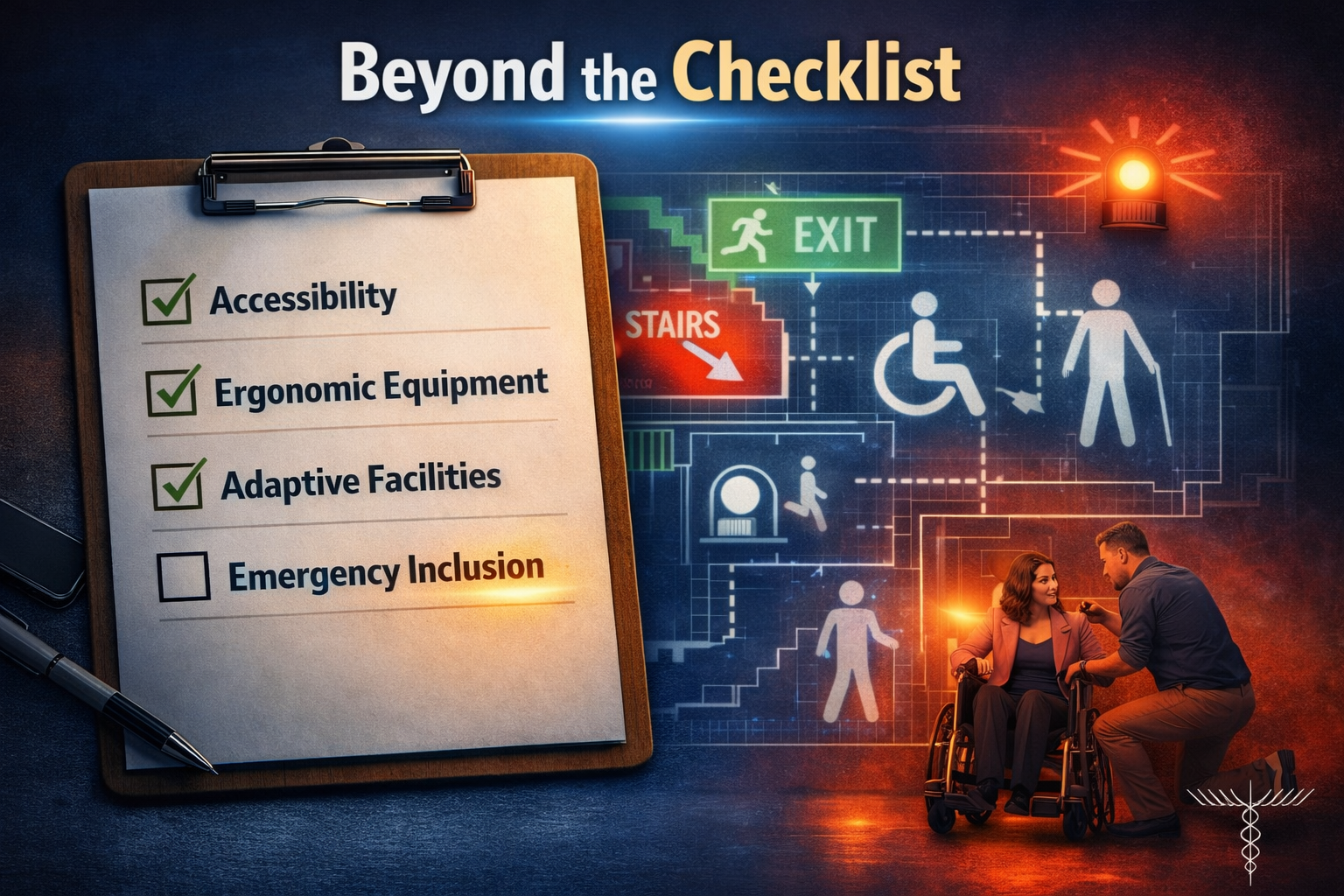
Workplace inclusion is often celebrated through visible adjustments — ramps, ergonomic desks, assistive technology, and flexible policies. These are vital, but they’re also the low-hanging fruit of inclusion. They make a workplace look accessible, yet they don’t always make it safe or equitable when it matters most.
In moments of crisis — fire alarms, evacuations, power failures — the difference between accessibility and inclusion becomes painfully clear. A ramp helps someone enter the building; an inclusive evacuation plan ensures they can leave it safely.
The Hidden Gap
Across industries, accessibility is treated as a compliance checkbox. HR teams, unions, and legal advisors often focus on physical access and equipment provision. But inclusion is not a static state — it’s a dynamic system that must hold under pressure.
When emergency plans overlook employees with mobility, visual, or hearing impairments, the message is clear: you belong here until something goes wrong.
Beyond the Tick‑Box
True inclusion means designing for every scenario, not just the everyday. It’s about embedding governance, planning, robust system design and empathy into operational planning — ensuring that safety drills, communication systems, and evacuation routes reflect the diversity and safety of the workforce.
It’s about moving from reasonable adjustments to responsible design.
The Cultural Shift
Inclusive safety isn’t a policy — it’s a mindset that is turned to proactive infrastructure. It requires collaboration between HR, facilities, health and safety officers, occupational health and employees themselves. It demands that we ask uncomfortable questions:
- Who gets left behind when the alarm sounds?
- Are our emergency procedures rehearsed inclusively?
- Do our communication systems reach everyone, in every format?
During COVID times and midst RTO mandates I was dealing with a case of a young woman who suffered a stroke following the birth of her child. The woman made good and speedy recovery; what the stroke left behind though, was total loss of peripheral vision. Luckily enough, in the country of her residency there had been a very good, responsive and reliable health system, including medical professionals, fit for purpose healthcare facilities, including rehabilitation facilities, and expert-led Neuro – Rehabilitation departments for people suffering with sensory, visual and hearing impairments. I first saw this lady in my clinic after her having completed the first 5 sessions with these experts. In a detailed report they provided expert advice on the DSE equipment needed for her office work along with the optimal light conditions. They had provided relevant training as well regarding day-to-day tasks and activities, including using stairs and driving. The real challenge came up when the RTO mandate came up. And here was the constructive interaction between the Occupational Health Team with the Expert Neuro-Rehab Team. On their front, they cleared the employee as fit to RTO. And honestly, I found it reasonable…
The employee had gladly opened a communication channel amongst herself, the Expert Neuro-Rehab Team and the Occupational Health Team (C’est moi et mon equipe!). Now the conversation had shifted to working together towards resolving the next challenge; safe-commuting. Walking? Driving? Public transport? Drop off service (provided by the employer)? The load of liability for a decision that seemed simple and straightforward at a first sight was disproportional. The employee appreciated the support with the wide breadth of reasonable adjustments recommended in a detailed occupational health report (that was greeted by the employee and the Nero-Experts) and realised the bottleneck; she liaised with HR directly and it was formally agreed that a drop off service would be provided by the employer with 6-monthly reviews.
In the same organisation hiring managers and HR were surprised when they saw outcomes “Fit for employment subject to emergency evacuation planning; please liaise with safety. Please consider an emergency evacuation companion” The outcome was linked to newcomers with mobility constraints (wheelchair users or other walk-assisting equipment), visual and hearing impairments and other invisible disabilities (ADHD, Dyslexia, Dyspraxia). When I was asked by the SMT to provide some reasoning for such recommendations, I turned straight away to the legal team of HR: ” Don’t imagine; just picture this: you boast about your headquarters’ emblematic tall, glass-built skyscraper and your employee in question (with mobility constraints or with visual or hearing impairment etc) is on the top floor or at least not on the direct emergency exit level; in the event of a fire, earthquake or even electrical failure how are they going to evacuate the premises? The room silence revealed/gave away the health & safety unaware culture.
Personal perspective and little matters to me whether it is an unpopular one: As ambassadors and architects of employees’/workers’ health; and safety’s; as occupational health specialists and experts it is a must to practice in our day-to-day practice our non-negotiables and zero tolerance in compromising practices. Compromises and discounts in Occupational & Environmental Medicine (OEM) and health and safety cost….from single liability (claims & reputation) to lives.