

By Maria Athanasiou MD MFOM MBA – Specialist & Expert in Occupational & Environmental Medicine
As global demand for AI, cloud computing, and digital infrastructure surges, data center construction has entered an era of unprecedented scale and speed. Facilities are larger, power densities are higher, and build schedules are increasingly compressed. While engineering, sustainability, and cybersecurity are routinely embedded into the earliest stages of project planning, one critical discipline is too often treated as an afterthought: Occupational & Environmental Medicine (OEM).
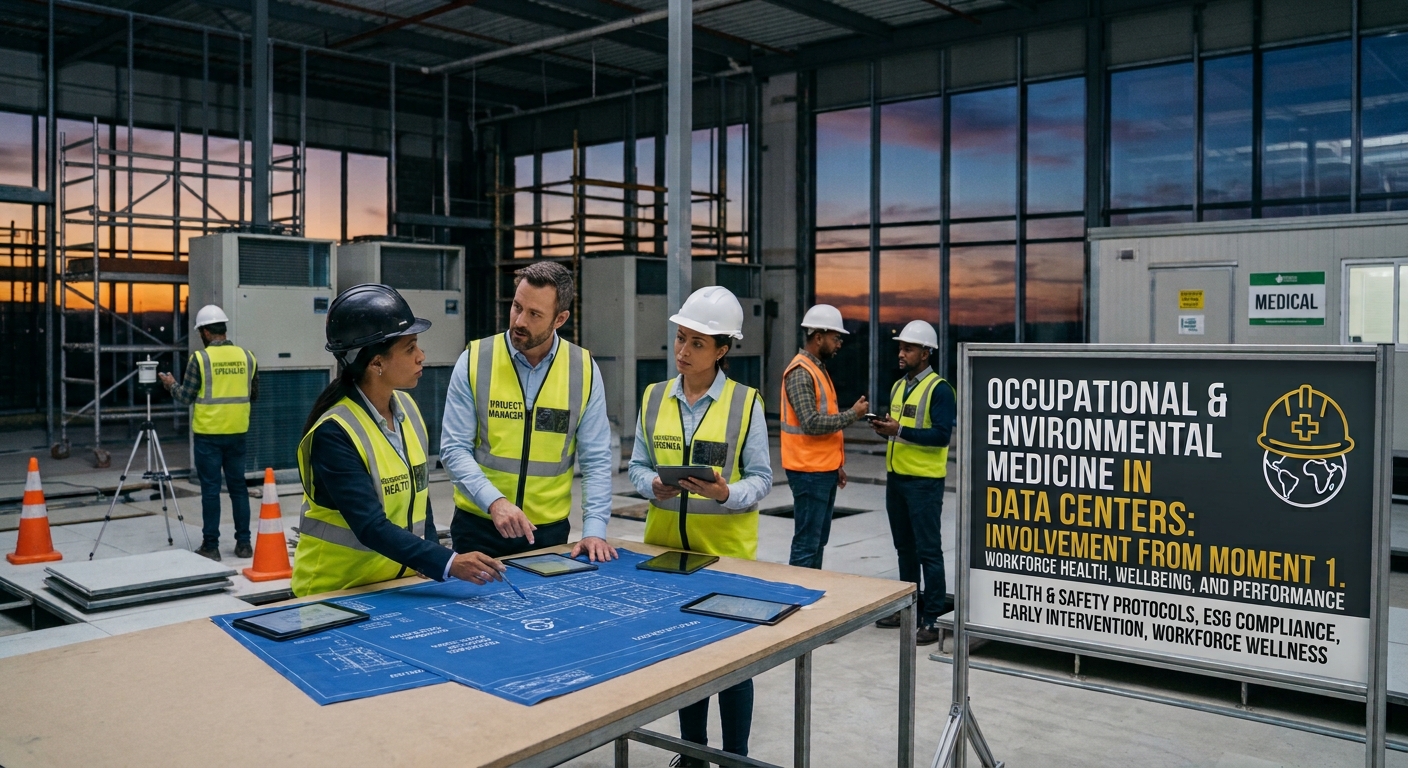
Traditionally, occupational health is brought in during late-stage commissioning or once operations begin—when physical layouts are locked in and operational workflows are already established. Shifting that timeline forward so OEM professionals collaborate alongside architects, geotechnical engineers, and project managers from the initial terrain survey and early construction phases is not just a compliance measure; it is a strategic investment in workforce health, community wellbeing, and long-term sustainability.
1. Ground-Zero Intelligence:
OEM at the Terrain Survey Stage: To truly capture the value of OEM from “Moment 1” involvement must begin well before the first foundation is poured—starting at the initial site selection and terrain survey stage. At this foundational phase, environmental and geological realities directly dictate the specifications, structural typology, and material quality of the build, all of which carry profound implications for human health and operational resilience:
Geological and Soil Profiles: Comprehensive surface and subsurface soil analyses—alongside regional geological assessments, including seismic activity prevalence—determine foundation engineering, vibration-dampening requirements, and excavation methods. For OEM professionals, these parameters are critical for anticipating worker exposure to hazardous subsurface contaminants (such as heavy metals, radon, or naturally occurring asbestos), managing silica dust/respirable crystalline silica during deep excavation, and specifying structural shock-absorption systems that protect both equipment and personnel from chronic whole-body vibration or seismic events.
Meteorological Extremes and Architectural Typology: Local meteorological data and the prevalence of extreme weather phenomena (such as heatwaves, high winds, flooding, or heavy snow loads) govern whether a facility pursues a sprawling horizontal footprint or a vertical, multi-story development. These structural determinants directly shape construction risk profiles—ranging from working-at-height protocols and crane operations in vertical builds to thermal stress management, indoor air filtration, and safe emergency egress design during severe weather events.
Water Quality and Energy Infrastructure: Early evaluation of groundwater and municipal water quality informs the specification of closed-loop vs. evaporative cooling systems, water treatment facilities, and corrosion-resistant piping—directly impacting the prevention of waterborne pathogens like Legionella and ensuring safe potable water for on-site teams. Simultaneously, planning for the on-site deployment of renewable energy sources (such as solar arrays, microgrids, or battery energy storage systems) introduces specialised high-voltage, chemical, and thermal hazards that must be engineered out through strict material specifications and spatial zoning from the very start.
2. Environmental Stewardship & Pollution Control:
Safeguarding Communities and Ecosystems Modern data centers are resource-intensive facilities that interact closely with their surrounding ecosystems. Early OEM integration ensures that environmental protection is built into the architecture rather than treated as an afterthought or a reactive fix:
Air and Water Pollution Prevention: Facilities rely heavily on emergency diesel generators and water-intensive cooling towers. Proactive environmental engineering establishes advanced emission scrubbing, ultra-low-sulfur fuel storage protocols, and closed-loop or grey-water recycling systems. This prevents airborne particulate and NOx contamination and protects local water tables from chemical runoff or thermal pollution that could harm aquatic fauna and community water supplies.
Radiation and Electromagnetic Fields (EMF): High-voltage substations, massive uninterruptible power supply (UPS) systems, and high-density server halls generate complex electromagnetic fields. Early spatial planning ensures proper shielding and safe setback distances to protect both on-site technical personnel from chronic occupational exposure and adjacent communities from long-term environmental health concerns.
Noise and Thermal Plume Mitigation: Continuous-duty cooling fans, chillers, and backup generators generate significant acoustic and thermal footprints. Designing acoustic louvers, strategic baffling, and optimised exhaust placement during the construction phase prevents noise pollution from degrading the quality of life for nearby residents and disrupting local wildlife habitats.
E-Waste and Hazardous Material Lifecycles: From server hardware and lithium-ion battery banks to chemical refrigerants, data centers generate specialised waste streams. OEM and environmental teams establish circular economy frameworks, secure recycling pipelines, and hazardous material containment protocols from day one, preventing toxic leaching into soil or groundwater for current and future generations.
3. Preventing High-Cost Retrofits Through Ergonomic and Structural Design:
Data centers are physically demanding environments for the technicians who maintain them. Once a facility goes live, workers routinely handle heavy server hardware, navigate tight hot- and cold-aisle containment systems, and work in environments with significant acoustic and thermal demands:
Equipment Handling and Access: Early OEM involvement ensures that server rack heights, aisle widths, and lifting clearances accommodate safe manual handling and mechanical lifting aids—eliminating awkward postures and reducing musculoskeletal disorders (MSDs).
Acoustic and Thermal Controls: Addressing acoustic dampening, ventilation pathways, and internal thermal zoning during the structural build is vastly more effective and economical than retrofitting barriers after commissioning.
4. Protecting the Construction Workforce During High-Velocity Builds:
The construction phase of a hyperscale or colocation data center presents distinct occupational health hazards. Compressed timelines often result in overlapping trades, extended shift patterns, and intense physical workloads:
Managing Exposure Risks: From excavation dust to welding fumes, chemical sealants, and high-decibel machinery, early OEM oversight establishes proactive health surveillance, exposure monitoring, and targeted respiratory and hearing protection protocols before hazards escalate.
Fatigue and Mental Health Management: Rapid-build schedules increase the risk of worker fatigue and burnout. Integrating OEM early allows project leaders to structure sustainable shift rotations, establish on-site wellness resources, and foster a culture where workers feel supported rather than pushed past safe limits.
5. Seamless Transition from Construction to Live Operations:
One of the most vulnerable periods in a data center’s lifecycle is the handover from construction to live operations, when commissioning engineers, IT technicians, and facility staff share active workspaces:
Hazard Alignment: When OEM teams participate from day one, they understand the building’s evolving risk profile—from high-voltage electrical systems and renewable energy storage to refrigerant and water-treatment handling.
Tailored Health Surveillance: Occupational health protocols, medical fitness assessments, and emergency response procedures are ready on day one of operations, preventing delays in onboarding critical technical staff.
6. Measurable Return on Investment (ROI) and ESG Compliance:
In an industry where downtime is measured in thousands of dollars per minute, human reliability and environmental stewardship are directly tied to facility reliability:
Workforce Health, Wellbeing, and Performance: Proactive health design lowers injury rates and chronic strain, keeping skilled technicians healthy, engaged, and performing at their peak.
Regulatory and ESG Alignment: Early integration ensures compliance with rigorous occupational and environmental standards while strengthening Environmental, Social, and Governance (ESG) metrics—an increasingly vital factor for investors, clients, and local communities who demand net-positive impacts on society and the environment.
Looking Ahead
Building a modern data center requires precision engineering at every level—from the soil beneath the slab to the servers in the hall, and out to the communities surrounding the perimeter. By bringing Occupational & Environmental Medicine to the table alongside geotechnical, structural, electrical, and mechanical leads from Moment 1, organisations protect the people who build and run these mission-critical facilities, preserve local ecosystems, and safeguard future generations—turning health, safety, and environmental stewardship from a reactive cost into a lasting operational advantage.