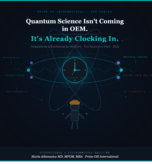

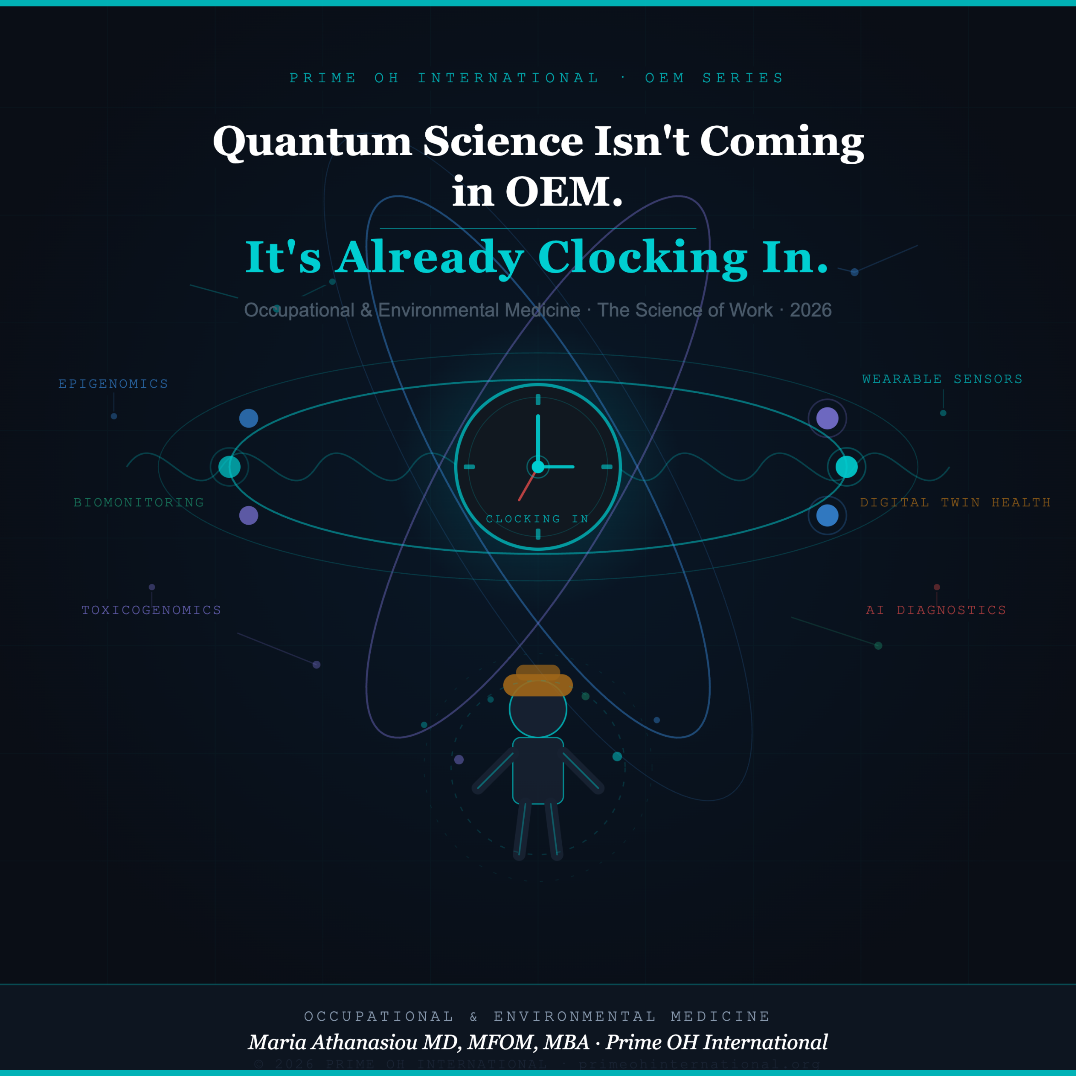
We talk about the future of Occupational and Environmental Medicine (OEM) as though it is somewhere on the horizon — arriving soon, pending further research, coming once the technology matures; let's talk about quantum science in OEM.

It is already here. It clocked in with the morning shift.

1. Quantum Sensing & Environmental Precision

Traditional environmental sampling relies on periodic laboratory testing. Quantum sensors—such as nitrogen-vacancy (NV) diamond centers and optical lattice clocks—measure magnetic fields, photon counts, and temperatures at microscopic scales.


Subatomic Hazard Detection: Continuous, real-time identification of ultra-trace toxic agents, airborne silica, and volatile organic compounds (VOCs) at single-molecule concentrations.

Fence-Line Plume Mapping:Quantum-enhanced LIDAR maps chemical plume dispersion patterns beyond facility boundaries in real time.

2. Neuro-Biometrics & Advanced Ergonomics

Brain-Computer Interfaces (qMEG): Optically Pumped Magnetometers detect minute changes in brain magnetic fields without cryogenic cooling, providing non-invasive, real-time measurements of cognitive overload, fatigue, and micro-sleep risks in high-consequence operations.

Sub-Millimeter Ergonomic Tracking: Quantum optical sensors track biomechanical movement and spinal shear forces at micro-degrees of precision, allowing real-time workstation adjustments to prevent cumulative musculoskeletal disorders.

3. The Human Boundary & Evidence-Based Realities

While quantum technology delivers unprecedented analytical resolution, it encounters a fundamental human limit:

Epigenomics is telling us that occupational exposures — diesel exhaust, night shift work, chemical agents — do not just cause disease. They rewrite the molecular instructions that govern how disease develops, at a cellular level, across a lifetime. The worker who spent twenty years on night shift carries that exposure in their methylation patterns long after the shift pattern changes. We are only beginning to understand what that means clinically. But we are no longer speculating that it means something.

Toxicogenomics is transforming how we measure biological exposure. Urinary 1-hydroxypyrene for diesel exhaust. Specific protein adducts for carcinogen exposure. Genetic susceptibility variants that explain why two workers with identical exposures develop different outcomes. The surveillance appointment that once produced a questionnaire and a spirometry reading can now produce a molecular picture of what the workplace has done to the body at the genomic level.

Wearable physiological sensors are replacing point-in-time surveillance with continuous monitoring. Core temperature. Heart rate variability. Noise dose accumulation in real time. The server hall technician crossing between a 12°C cold aisle and a 55°C AI rack hot aisle dozens of times per shift — their cardiovascular cycling load is not a theoretical calculation. It is now a measurable, continuous, wearable data stream.
AI-driven diagnostic pattern recognition is finding signals in surveillance data that no human clinician — reviewing individual records in isolation — could detect. The cluster of audiometric threshold shifts that maps to a specific work zone. The PHQ-9 trajectory that predicts long-term mental health absence six months before the first sick day. The Legionella exposure pattern that connects three cases across two facilities before the outbreak is formally identified.

Digital twin health modelling is enabling us to simulate the physiological consequence of work design decisions before a single worker sets foot in a building. The thermal model of the server hall. The noise map of the plant room. The ergonomic load calculation for the logistics role. Before the facility is built. Before the damage is done.

This is not science fiction. This is Occupational and Environmental Medicine in 2026.

The discipline that Bernardino Ramazzini founded when he asked tradesmen about their work in 1700 — "What is your occupation? And what do you do in it?" — is now asking that question at the molecular, genomic, and digital level simultaneously.

The worker has not changed. They still clock in every morning. They still carry their body to work and bring it home at the end of the shift — or do not, when the governance fails them.

What has changed is our ability to understand, measure, and protect what happens in between.

Quantum science is not coming to Occupational and Environmental Medicine.

It is already here.

It just needed someone to notice it had clocked in. It's our call to deploy it in the best interest of workers' health and performance.
-
Cognitive Biases (System 1 Thinking): Evolutionary traits like overconfidence bias, normalcy bias, and confirmation bias drive human error. A quantum sensor can detect a hazardous gas plume, but it cannot stop a worker from bypassing a safety interlock due to perceived time pressure.
-
Violations vs. Errors: Safety frameworks distinguish between accidental slips and deliberate rule violations. Quantum processing optimizes technical systems, but it cannot replace organizational safety culture or executive accountability.
-
The Imperative of Specialist Interpretation: High-resolution quantum telemetry requires expert clinical interpretation. Translating complex biological and environmental data into safe workplace practice demands accredited OEM medical specialists who understand both physiology and human behavior.
** "Quantum science can map the subatomic universe, measure picotesla magnetic fields, and model complex environmental systems, but quantum science cannot tackle or uninstall human stupidity."

💡 Summary Perspective

Occupational & Environmental Medicine sits at the nexus of human rights, public health, economic resilience, environmental protection, and executive strategy. By enforcing strict accreditation standards and integrating advanced scientific tools—from toxicology to quantum sensing—OEM fulfills its true purpose: serving as an evidence-based driver of human prosperity and corporate strength.