
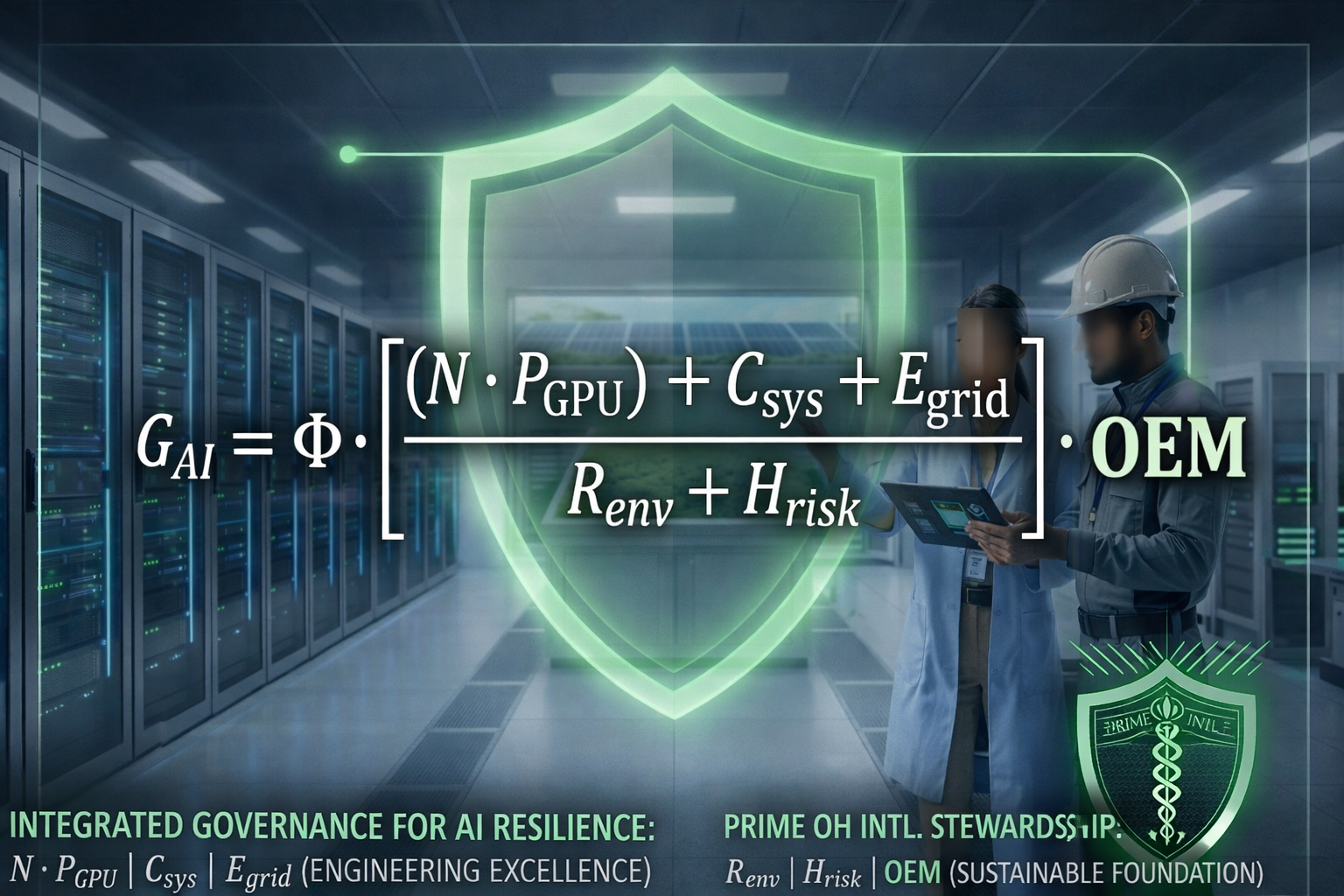
GAI = Φ × [ ((N × PGPU) + Csys + Egrid) / (Renv + Hrisk) ] × OEM
Where:
GAI = Total Sustainable Governance & Operational Integrity of the AI Infrastructure.
N × PGPU = Compute Capacity (Number of GPUs × Processing Power per GPU).
Csys = Efficiency and Capacity of the Cooling Systems (liquid and ambient air).
Egrid = Energy Grid Stability and Power Inputs.
Renv = Environmental Strain Metrics (Groundwater draw, air emissions, carbon equivalents).
Hrisk = Human Risk Factor (Total Recordable Incident Rate, ergonomic strain, cognitive fatigue).
Φ (Phi) = Standard regulatory and operational compliance constant.
OEM = The Occupational and Environmental Medicine Multiplier.
In the AI Infrastructure Governance Equation, OEM is not the star of the show; it is the supporting layer. To ensure this reads with deep humility and respects the engineering backbone, the explanation frames the numerator as the “Active Hero” (the massive digital engine keeping nations alive) and OEM as the “Sustaining Foundation” (the quiet guardian preventing that engine from burning out).
The Mathematics of Sustainability: Deconstructing the Governance Equation
To understand how a digital ecosystem scales without collapsing, we look to the AI Infrastructure Governance Equation. This formula mathematically models the delicate equilibrium between raw computational power, engineering excellence, and the environmental and human systems that support it.
By breaking the equation down into its core scientific components, we see a harmonious relationship between the digital backbone and occupational health stewardship.
1. The Numerator: The Engineering Backbone (The Muscle)
The numerator represents the active, tangible power of the data center. This is the magnificent technical architecture designed by engineers and technicians to keep the digital world alive:
Compute Density: The total processing capacity, where N is the number of clusters and PGPU is the performance index per unit. This is the raw computational engine driving the AI evolution.
Thermal Management Capacity: The thermodynamic efficiency of the liquid cooling loops, heat exchangers, and HVAC units required to dissipate the massive thermal energy generated by high-density computing.
Energy Infrastructure: The input power stability, encompassing renewable grids, substation integrations, and uninterruptible power supply (UPS) configurations.
2. The Denominator: Systemic Friction & Resistance (The Stressors)
Every powerful engine generates resistance. The denominator represents the biological and environmental tax that a 24/7 high-density infrastructure levies on its surroundings:
Environmental Strain: The measurable footprint of the facility, including localized groundwater drawdown, chemical cooling tower effluents, diesel particulate matter emissions from backup grids, and the wider e-waste lifecycle.
Human Risk Factor: The cumulative physical and psychological hazards faced by the workforce—ranging from high-frequency acoustic noise exposure and chemical handling risks to ergonomic strain and circadian rhythm disruption from high-stakes shift work.
3. The Φ (Phi): The Operational Baseline
This constant represents the standard regulatory framework, baseline compliance metrics, and local zoning laws within which the data center must legally operate.
4. The OEM Modifier: The Sustaining Foundation (The Shield)
The most critical aspect of this equation is the position of OEM (Occupational and Environmental Medicine). It sits as an external systemic multiplier rather than an asset in the numerator.
This positioning is intentional and humble: OEM does not generate the computing power; the brilliant engineers and technicians do. Instead, OEM acts as the stabilization factor for the entire matrix.
Preventing Exponential Decay: If human risk and environmental strain are left unmanaged, the denominator balloons. Mathematically, a surging denominator forces the overall governance score to plummet toward zero, resulting in operational downtime, systemic burnout, and regulatory intervention.
The Resilience Multiplier: When a framework like Prime OH Intl.’s is actively applied, OEM systematically drives down the denominator by protecting workers’ health, preserving local groundwater networks, and safeguarding ambient air quality.
The Immune Role of Occupational & Environmental Medicine (OEM) in AI Infrastructure: The Invisible Shield of the Digital Ecosystem
The global rush to dominate the Artificial Intelligence (AI) landscape has ignited an unprecedented infrastructure boom. Mega-data centers, sprawling server farms, and complex cooling grids are materializing at a breakneck pace. Yet, while the world marvels at liquid cooling loops, 100k-GPU clusters, and skyrocketing teraflops, a critical question remains largely unaddressed:
Who protects the human and environmental architecture keeping the digital brain alive?
Here is when and where Occupational and Environmental Medicine (OEM) enters the equation; not at the end of the project, nor down the road… right from moment one. Far from being a passive human resources or compliance function, OEM is the biological immune system of the AI infrastructure. It is the touchstone component that ensures the sustainability, safety, and peak performance of the data centers powering our modern existence.
Why OEM occupies this specific position in the equation:
In this equation, OEM operates as a systemic multiplier applied to the entire infrastructure matrix.
If OEM is ignored or poorly managed, the human risk and environmental strain expand exponentially, causing the denominator to balloon. Simultaneously, an OEM score approaching zero completely collapses the overall governance value, resulting in catastrophic operational failure, lawsuits, worker walkouts, or regulatory shutdowns.
Conversely, when a premier framework like Prime OH Intl.’s is fully optimized, it drives down human and environmental risks while acting as a force multiplier that stabilises, protects, and scales the entire computational system.
1. The Digital Backbone’s Biological Vulnerability
We tend to think of AI as ethereal cloud code, but its physical reality is heavy industry. Data centers are high-risk, high-complexity industrial environments. The human capital required to build, maintain, optimize, and decommission these facilities faces a unique cocktail of occupational hazards.
OEM specialists act as the frontline defense against these invisible stressors:
The Acoustic Toll: Server halls generate continuous, high-frequency ambient noise from thousands of cooling fans. OEM professionals design and monitor rigorous hearing conservation programs to prevent permanent auditory damage.
Thermal and Microclimatic Stress: Workers frequently transition between the intense heat of “hot aisles” and the chilled precision of “cold aisles,” or brave severe outdoor elements maintaining external HVAC and solar grids. OEM provides the medical protocols to mitigate heat stress and thermal shock.
Advanced Chemical Hazards: The shift toward liquid cooling introduces specialized dielectric fluids, refrigerants, and chemical water treatments. OEM specialists understand the toxicological profiles of these agents, managing exposure risks and emergency protocols.
Ergonomic and Musculoskeletal Strain: Swapping heavy server blades in tight, awkward spaces leads to repetitive strain and acute musculoskeletal injuries. OEM integrates biomechanical assessments directly into workflow designs.
2. Environmental Medicine: Safeguarding the Surrounding Ecosystem
The “E” in OEM is where digital sustainability truly meets public health. Data centers do not exist in a vacuum; they interact heavily with local environments. OEM specialists bridge the gap between corporate infrastructure and community health by managing a wider macro-environmental footprint:
E-Waste and Heavy Metal Toxicities: The rapid lifecycle of AI hardware creates a massive stream of electronic waste. OEM ensures that recycling and disposal processes do not expose workers or local water tables to neurotoxins like lead, cadmium, and beryllium.
Resource Strain and Emissions: Massive diesel backup generators, cooling tower emissions, and localized heat island effects can impact community air and water quality. OEM monitors these environmental touchpoints to prevent systemic health liabilities.
The “Heat Island” Amplification: Massive HVAC and heat rejection systems pump gigawatts of thermal energy directly into the local atmosphere, altering microclimates and potentially compounding urban heat stressors.
Upstream Supply Chain Toxicity: The extraction of rare earth elements for AI chips and the disposal of toxic e-waste (containing mercury, lead, and flame retardants) represent a global health footprint. OEM frames this not just as a supply chain issue, but as a boundaryless public health mandate.
Groundwater Network Systems & Hydrological Strain
Data centers are aggressively thirsty. A single large AI facility can consume millions of gallons of water daily, primarily evaporated to keep high-density server racks cool. This puts OEM specialists at the intersection of hydrogeology and public health:
Aquifer Depletion: Pumping massive volumes from local groundwater tables risks dropping the water table, threatening agricultural yields and community drinking supplies.
Thermal Pollution & Chemical Runoff: Water discharged from cooling towers (blowdown water) often contains highly concentrated anti-scaling chemicals, biocides, and corrosion inhibitors. If this breaches the groundwater network or local streams, it introduces systemic ecotoxicological risks that OEM professionals must audit and mitigate.
Microclimatic Air Quality: Internal vs. External Boundaries
The air management of an AI infrastructure unit is a dual-front battle:
The Internal Airscape: Inside the server halls, the main challenges are high-velocity airflow particulate suspension and potential chemical off-gassing from heated circuitry and synthetic materials. Furthermore, emergency deployment of gaseous fire suppression systems (like clean agent halocarbon replacements) requires strict OEM protocols to ensure worker safety during accidental discharges.
The External Ambient Air: Externally, the primary threat stems from Diesel Particulate Matter (DPM) and Nitrogen Oxides (NOx) emitted during routine testing or emergency activation of massive industrial backup generator fleets. OEM specialists assess the ambient plume dispersion to ensure these toxic emissions do not compromise the respiratory health of nearby communities or on-site workers.
3. High-Performance Environments Demand High-Performance Minds
AI infrastructure operates on a relentless 24/7/365 clock. A single minute of data center downtime can cost millions of dollars and disrupt critical global networks. This environment creates immense psychological pressure for the engineers, technicians, and cyber-sentinels keeping the lights on.
OEM addresses the invisible threat of cognitive fatigue and burnout:
Shift Work and Circadian Disruption: Continuous rotation schedules erode sleep architecture, degrading cognitive performance and increasing human error rates. OEM designs evidence-based shift schedules and sleep hygiene interventions.
Psychosocial Resilience: Operating under high-stakes, zero-downtime mandates requires robust mental health frameworks. OEM builds proactive psychological monitoring systems to support tech workers before burnout leads to critical operational failures.
The Ecosystem of Health Strategy
True workforce balance can be framed as an integrated system:
Seco = OEM + OHS + ESG + Compliance + Workforce Wellbeing
4. The ROI of OEM: Moving from Cost Center to Sustainability Enabler
In the boardroom, sustainability is often narrowly defined through Power Usage Effectiveness (PUE) or carbon offsets. True sustainability, however, requires human sustainability.
When Prime OH Intl. and OEM frameworks are deeply embedded into AI infrastructure strategy, they yield massive dividends:
Business Continuity: By predicting and preventing injury trends, OEM guarantees that the hyper-specialized talent pool required to run these facilities stays healthy and on-floor.
True ESG (Environmental, Social, Governance) Integrity: Modern investors look past greenwashed press releases. Robust occupational health metrics are concrete proof of the “S” (Social) and “E” (Environmental) in ESG compliance.
Conclusion: No AI Evolution Exists Without Human Resilience
The algorithms of tomorrow cannot run without the physical infrastructure of today, and that infrastructure cannot survive without human vitality.
As we scale the digital ecosystem to unprecedented heights, Occupational and Environmental Medicine is not an optional luxury—it is one of the touchstone foundations. By protecting the human element, safeguarding local environments, and optimizing cognitive performance, OEM ensures that the future of AI is not just fast and powerful, but resilient, safe, and truly sustainable.