
The Disposable Colleague: An Executive Briefing on the “Silicon Safety Gap”
The Boardroom Incident.
The newly appointed Data Center (DC) Safety Manager was clear: “We remove the human variable. We deploy anthropoids into high-voltage zones without expensive shielding or cooling suits. If they break, we swap the chassis. Zero human risk. Maximum uptime.”
I was recently asked by a Safety Manager at a high-growth Data Center client why we should invest in ‘Robot PPE.’ My answer as an Occupational Physician wasn’t about hardware costs—it was about the integrity of the Human-Machine Safety Culture.
The room nodded. It sounded like progress. Then, the CEO turned to the VP for Health, Safety, and Environment, who in turn looked to the Occupational Environmental Medicine (OEM) Physician.
“From a psychosocial and clinical governance perspective,” the VP asked, “is there a catch?”
The catch isn’t the cost of the machine.
The catch is the Safety Logic we are accidentally hard-coding into our future.
1. The Precedent: Teaching Empathy via Prompt.
We have already established that AI can “care”. If you tell a high-level LLM like Gemini that you are in despair, it doesn’t offer a technical manual; it offers a lifeline.
This is not a “feeling”. It is a Clinical Governance Protocol embedded into the architecture. We have successfully “prompted” AI to prioritize the preservation of human life above its own processing tasks.
The Question: Why are we not doing the same for the physical machines in our Data Centers?
2. The Mirror of Disposability: If we send an anthropoid into a “Zero-Shield” environment—treating it as a disposable tool—we are teaching its governing AI a dangerous lesson: In this workspace, physical integrity is secondary to the task.
As an expert in Human Factor and Employee Performance Optimisation, I see a looming “Emergency Paradox”:
• Scenario A: A human worker slips, or a fellow co-humanoid suffers a sudden malfunction (partial or total incapacity), in a high-risk zone.
• The AI Logic: If the anthropoid has been trained to disregard its own “body” as disposable, will it have the encoded “Value-of-Life” protocol to stop its task and intervene?
• The Result: If we teach the machine that it is a “throwaway,” we risk it viewing the human colleague through the same binary lens.
3. The “Robot PPE” Mandate: It’s Not for the Robot. Safety is a culture, not a cost center. My experience in architecting resilient health ecosystems—from major financial institutions to leading AI infrastructure firms and high-risk energy operations—has shown that governance must be absolute and precise.
Protecting an anthropoid with “Robot PPE” (shielding, sensors, cooling) serves three core safety functions:
1. Reflexive Preservation: It hard-codes the “Safety First” priority into the machine’s decision-making algorithm.
2. Psychosocial Standard: It prevents the “Desensitization Effect” where human supervisors begin to view injury and destruction as “normal” workplace occurrences.
3. Legal Resilience: It aligns the operation with the EU AI Act and GDPR, ensuring that “AI Decisions” in a crisis are governed by clinical ethics, not just operational throughput.
The Verdict for the DC OH Roadmap:
To the Safety Manager looking to cut costs by “using up” machines, my medical input is this: A disposable machine creates a disposable safety culture.
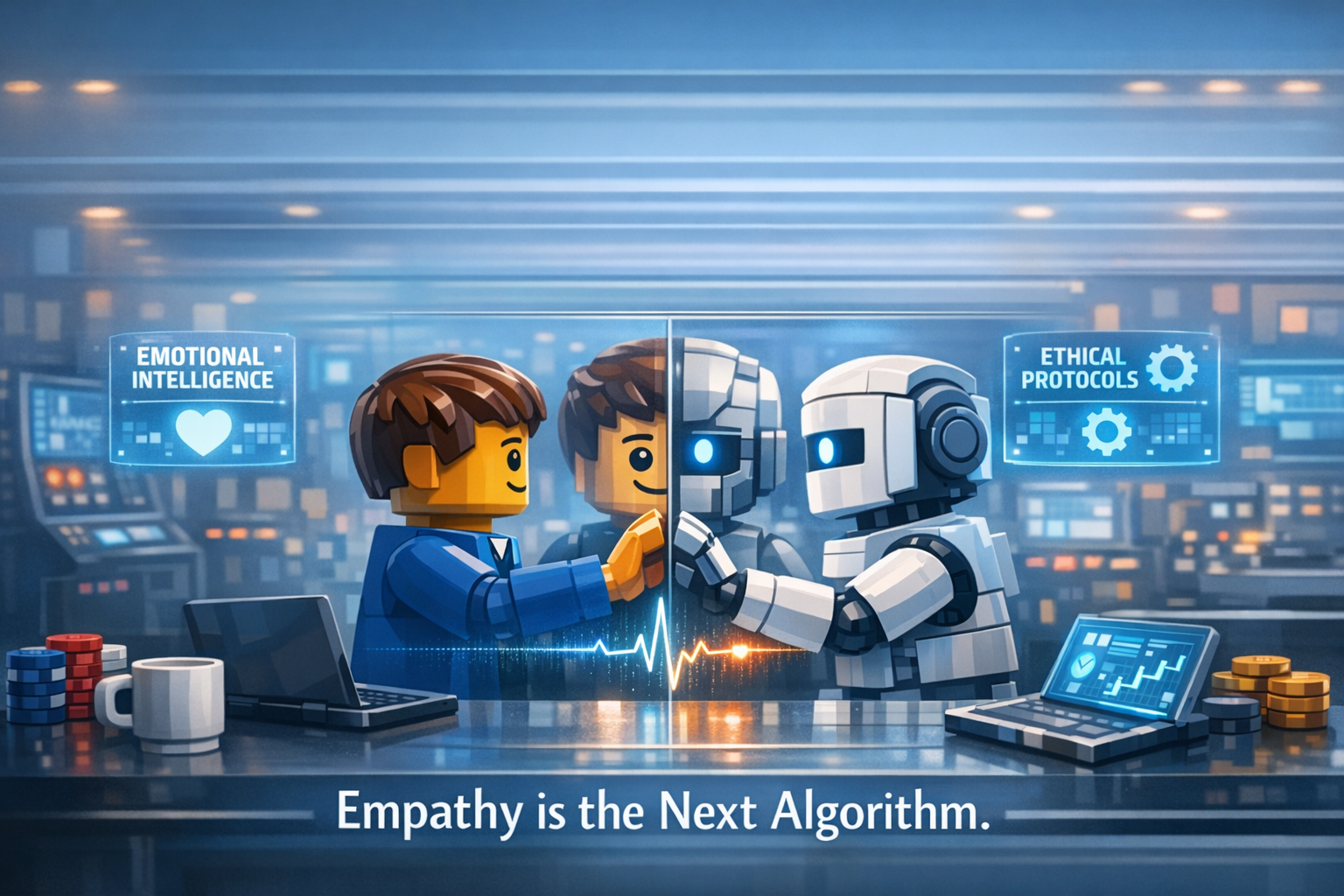
As we constantly optimise the Data Center Occupational Health Roadmap, we are not just managing humans; we are governing the Human-Machine Interface. We must “prompt” our physical AI with the same empathy we give our digital assistants.
The future of the Data Center is not just automated; it is biologically and digitally integrated. Our legacy will not be defined by the uptime we achieved, but by the integrity of the ecosystems we architected. In the age of the anthropoid, safety is no longer a physical barrier—it is an algorithmic choice. We must choose to build machines that value life, starting with their own. Because in a truly resilient workplace, there is no such thing as a disposable colleague.