
In modern corporate environments, the terms Conflict Management and Conflict Resolution are frequently used interchangeably. However, conflating the two conceals a fundamental strategic distinction:
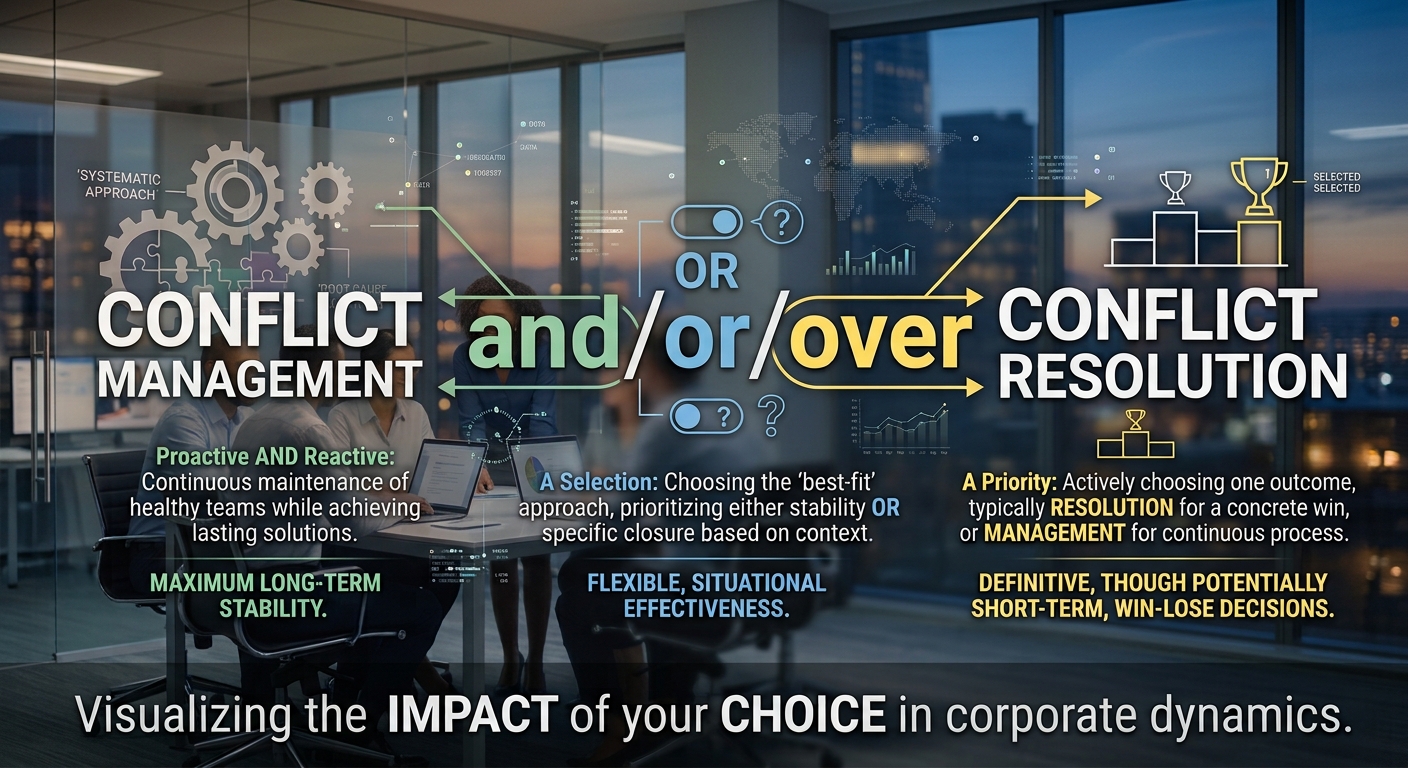
Management is an ongoing practice focused on optimizing interactions, maintaining healthy communication, and leveraging functional friction;
Resolution is a targeted intervention designed to bring a specific dispute or root problem to a definitive conclusion.
Understanding whether an organization requires conflict management, resolution, or an integrated combination of both directly influences team dynamics, operational costs, and long-term workplace culture.
The Anatomy and Physiology of Conflict begins with the clash of divergent needs, values, perceptions, or goals within an organization, functioning much like an immune response to a perceived threat or disruption. Its structural anatomy is built upon underlying triggers—such as scarce resource allocation, misaligned incentives, role ambiguity, or personal value mismatches—that create latent friction between individuals or teams. When activated, the physiology of conflict manifests as a dynamic system of psychological and behavioral reactions: heightened emotional arousal, narrowed cognitive processing, defensive communication patterns, and tribal alignment into competing factions. Left unaddressed, this physiological systemic response can degrade trust, drain organizational energy, and cause widespread operational dysfunction. However, when understood as a natural mechanism of organizational evolution, conflict acts as a vital diagnostic signal that highlights structural weaknesses, hidden inefficiencies, and untapped opportunities for innovation that require systemic attention.
The Anatomy and Physiology of Conflict Management operates as the continuous cardiovascular system of an organization, designed to regulate, channel, and optimize ongoing functional tension without attempting to eradicate it entirely. Its anatomical foundation consists of established feedback channels, clear operational boundaries, structured communication frameworks, and psychological safety protocols embedded into everyday leadership practices. The physiology of conflict management is an ongoing, adaptive process: it continuously monitors workplace dynamics, actively de-escalates destructive emotional spikes, and steers friction away from personal attacks and toward creative problem-solving. Rather than seeking a permanent end to disagreement, its physiological function is to maintain a healthy baseline of constructive dissent—allowing diverse viewpoints to sharpen ideas, drive innovation, and prevent organizational stagnation, while simultaneously keeping toxic interpersonal behaviors and systemic burnout in check.
The Anatomy and Physiology of Conflict Resolution serves as the targeted surgical intervention of an organization, engineered to diagnose, treat, and permanently address specific, acute disputes. Its anatomy comprises formal diagnostic procedures, root-cause analysis tools, interest-based negotiation models, mediation protocols, and clear contractual or consensus-driven agreements. The physiology of conflict resolution is an event-driven, step-by-step healing process: it isolates the specific point of contention, strips away surface-level positions to reveal underlying interests, and facilitates a structured dialogue designed to achieve mutual alignment or consensus. Once an effective resolution is executed, the physiological cycle concludes by restoring trust, repairing broken working relationships, and establishing clear accountabilities to prevent the exact same dispute from recurring. Unlike continuous management, resolution aims for definitive closure, transforming a state of active discord into a stable, aligned outcome where all parties can move forward productively.
The Sustained Equilibrium of Unresolved Friction recognizes that not all conflicts require—or even benefit from—a definitive resolution; in fact, attempting to force closure on every point of disagreement can be counterproductive to organizational health. Instead of viewing persistent tension as a defect to be eliminated, healthy systems treat managed conflict as a vital homeostatic mechanism contributing to balance, continuously adjusting the organization’s internal environment to absorb external pressures without fracturing. This ongoing dynamic relies heavily on respecting boundaries between individual roles and responsibilities, while deeply appreciating cultural differences in how tension is expressed, navigated, and processed across global teams. Furthermore, it functions within a framework of following and complying with a governance model that provides stability and order, even while actively objecting to derailed ones—such as toxic power structures, unethical directives, or obsolete policies—that threaten the organization’s integrity. By deliberately choosing to manage and live with certain strategic frictions rather than rushing to resolve them, organizations preserve the creative strain necessary for innovation, safeguard ethical dissent, and maintain a resilient state of dynamic equilibrium.
A few years back I had a manager; she was a lawyer; the Head of Division of Employees Relations of a medium-sized yet very powerful organisation. A lovely individual, nice and polite in meetings, accepting smoothly disagreement and opposition to her narrative whenever it occurred. All correspondence and interaction with her rolled smoothly up until her hierarchy started imposing their desired outcomes in HR legal health-related cases. Back at the time, I was still a beginner in my UK medico-legal witness expert training and mid-my EU and International Employment Law one; I had access to databases and sources of the local jurisdiction (Luxembourg in this case) and based on the local jurisdiction the requested outcome (!!!) was totally illegal. I was not surprised that the request came in the form of a discussion in a meeting without note keeping/without records/without “minutes”/ without meeting agenda. That would be an evidence. During the meeting I suggested to stop it and continue once the request comes first in an official email as part of the agenda of that meeting (evidence). Guess what? It never happened. Communications and threads continued in the spectrum of politeness and professionalism but from that moment onwards with a distinct ‘mild tension” and “mandates” . Inboxes started heating up, emails became more instructive than usual. It was obvious that the conflict beneath was not with my reporting line per se, but with her hierarchy; and, on my front it was pretty manageable and… most welcome; with a confident feeling kind of … ” I have it/ I can handle this”. The Head of Division of Employees Relations was not a bad person, she was not a stupid woman and professional. Actually she had amazingly fast reflexes, interpreting almost unmistakably verbal and non- verbal queues; I had scanned this trait from the very first meetings we had; she was and I believe that she still is an amazing professional in her area of expertise. But being a people pleaser and a yes-person is controversial whether it is the right ticket for career progression. After my last email ” Following the past weeks’ thread I find the approach that you followed (employee temporary suspension-for a month-) totally irrational and out of any legality. I know you have based your decision on the “staff rules” but just a recommendation; make sure the rules you have in place are complying with the local (Luxembourgish) jurisdiction; you are more knowledgable on this than I am. As things finally evolved in this place and in this collaboration, I have nothing more to contribute in this team and organisation. I don’t know if this quote belongs to Einstein as many people claim but I fully second that: ” The difference between stupidity and genius is that genius has a limit” and I will add that ” Never argue with stupid people, they will drag you down to their level and then beat you with experience” ” she changed immediately the communication contact, not my line management though (herself). I left that contract with the feeling of “I have wasted precious career time with them” for that one year of service in that organisation.
The takeaway was clear and has stayed with me ever since: Conflict management is essential but it does not need to mean conflict resolution. There are times that there is no room whatsoever for arbitration/negotiation/compromise when it comes to integrity and professionalism; integrity is part of our professional brand.
I have urged ever since my teams to reconsider their mandatory training courses; personal opinion but management is more pragmatic and fit for purpose than resolution. Managements gives potentials whereas resolution creates the falsely-perceived idea that something has been sorted finally… but…has it…and, finally…?
Heartfelt thanks to Diana, Emily, Sean, Matt, Mandy, Anastasia and Pascale; all of them lawyers who have shaped and transformed my medico-legal expertise into an international brand embedded into my expertise in Occupational & Environmental Medicine.