
Zanzibar 05.30
Deep dive into “The Anatomy of Burnout” by. J Razavi and the “Job Stress Revisited” by Quentin Durand-Mureau, both esteemed colleagues and researchers. After the first dive in the calm sea it is the best time for an early morning read. These books triggered my curiosity; do my burnout patients /cases present a specific pattern? How many patterns have I recorded throughout my annual audits and the 10-year one? Plus one more case…
For decades, we’ve been handed a simple career map: Up and to the Right. It’s a clean line, emphasising constant growth and linear progression. Then, we realise that career pathways are not linear. And this is where we build resilience, resistance, consistency and perseverance.
But experience tells us that the real journey is far more complex. It’s not just about speed; it’s about the distinct stations we pass through—some of which are designed to silently derail us.
We spend considerable energy discussing the main stop (Burnout), but very little time on the subtle stops that lead there. It’s time we acknowledged the silent decline and the intentional pivot required for renewal.
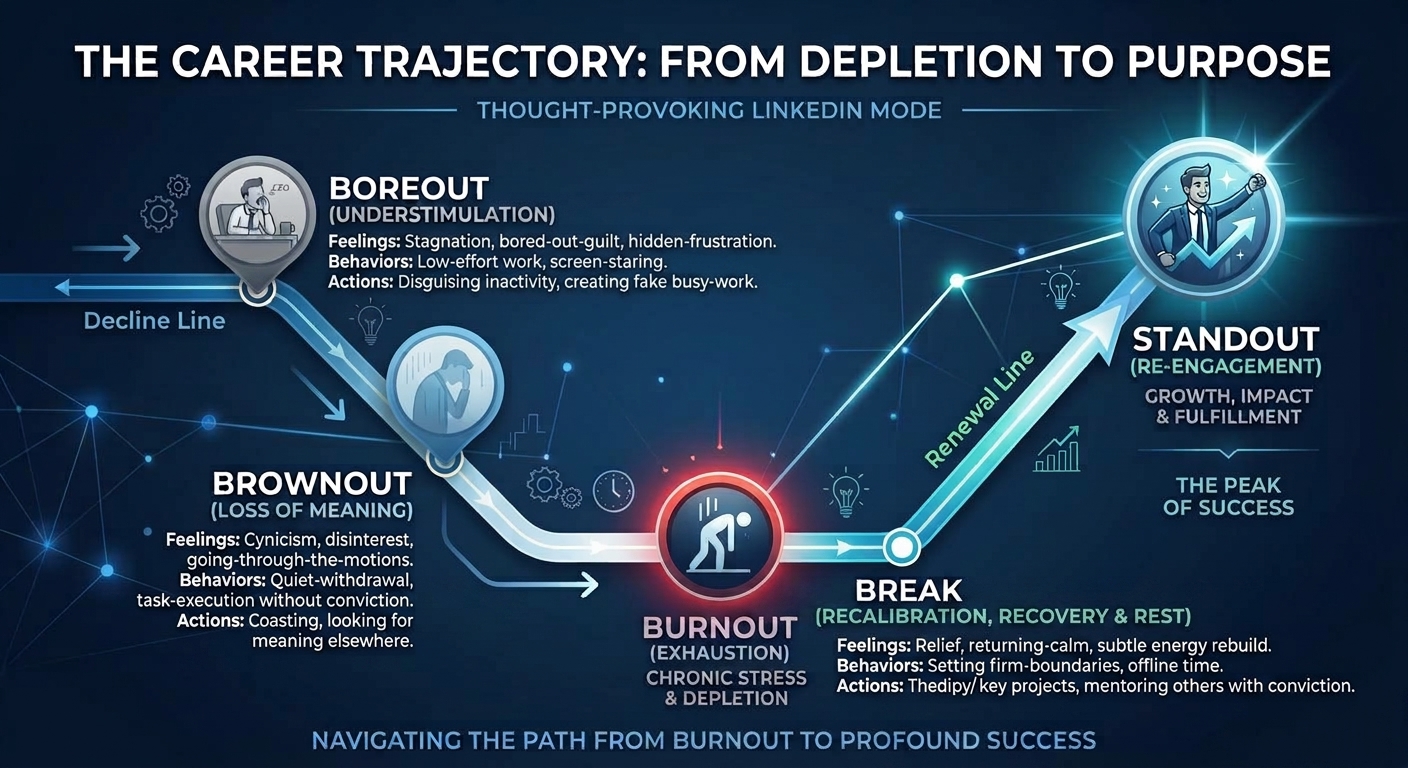
Look at this refined Career Trajectory visual. It breaks down the progression from depletion to genuine purpose. Let’s elaborate on each “station” on this map:
The Stations of Silent Decline (The Falling Path) and the Rising One (Stand Out)
Station 1: BOREOUT (Understimulation)
This is the silent killer of engagement, represented by the deep blue, initial dip. Boreout isn’t about being lazy; it’s about chronic underutilization. Your skills are high, but the challenge is critically low. This results in apathy and a feeling of wasted potential.
Why it’s dangerous: Because it looks comfortable to outsiders, but it is deeply eroding to your professional self-worth.
Feelings: Stagnation, quiet frustration, invisible guilt, acute boredom masked as calm.
Behaviours: Staring at screens while waiting for the day to end, fake-busy work, procrastinating simple tasks because they lack challenge, checking emails repeatedly.
Actions: Over-engineering simple projects to stretch time, avoiding volunteering for new initiatives out of sheer apathy, keeping head down in meetings to avoid being assigned “more of the same.”
Station 2: BROWNOUT (Loss of Meaning)
You haven’t quit, and you may even be performing well, but the ‘why’ has evaporated. Brownout is characterized by a high-functioning individual going through the motions. Outwardly you are successful; inwardly, you are empty, navigating a complex web with no direction.
Why it’s dangerous: This can last for years. You become a hollow high-achiever, disconnected from both your team and your own fulfilment.
Feelings: Disconnection, cynical detachment, “going through the motions,” feeling like a cog in an indifferent machine.
Behaviours: Meeting key performance metrics with precise efficiency while completely disengaging emotionally, rolling eyes during company vision announcements, quiet withdrawal from team social events.
Actions: Executing tasks strictly within job description scope (quiet quitting), venting privately about management’s lack of vision, actively searching for exit strategies or alternative roles during work hours.
Station 3: BURNOUT (Chronic Exhaustion)
This is the crisis point—the junction. Chronic stress has now overwhelmed your capacity. Mentally, emotionally, and physically, you have reached zero. It is not just “fatigue”; it is complete depletion. Momentum stops entirely.
Why it’s dangerous: It forces radical change. It is the most costly stop on the map, usually requiring complete removal from the tracks.
Feelings: Total physical and mental depletion, overwhelming dread at simple notifications, paralysis, chronic irritability, feeling completely trapped.
Behaviors: Missing deadlines due to cognitive fatigue, emotional outbursts or complete emotional numbness, dropping the ball on basic daily communications, physical symptoms (headaches, insomnia).
Actions: Taking sudden medical/sick leave, completely stepping back from projects, making impulsive decisions (e.g., quitting without a plan), or shutting down communication entirely.
Station 4: RECOVERY & RECALIBRATION (The Rising Path)
The critical insight of this map is what happens after Burnout. Note that the line changes from a descending blue to a rising, bright blue/white spectrum only after the crucial ‘BREAK.’
Turnaround & Growth Phase: The Energy Rebuild & Recalibration
Feelings: relief mixed with residual anxiety, gradual mental clarity, emergence of curiosity, returning physical energy.
Behaviours: Unplugging from workplace communication channels, sleeping without alarms, engaging in non-work creative or physical activities, setting firm boundaries around personal time.
Actions: Auditing personal values and priorities, engaging in professional coaching or therapy, declining non-essential commitments, designing a sustainable workload strategy.
This is not a vacation; it’s a fundamental recalibration. It’s the necessary stillness required to reset the tracks. It demands ruthless prioritize of rest over productivity. You cannot reach the next station without first completing this stop.
Station 5: STANDOUT (Re-engagement & Growth)
This is the true destination: reaching a sustainable peak of meaningful impact. Following the break, Standout is where renewed energy aligns with profound purpose. You are no longer just performing; you are contributing. You lead with authenticity and experience sustainable fulfilment.
Why it’s powerful: It’s not about the highest salary; it’s about high-performance that is energising rather than draining.
Feelings: relief mixed with residual anxiety, gradual mental clarity, emergence of curiosity, returning physical energy.
Two years ago I felt the need to implement myself the advice I had been giving to managers, employees, HR, patients (not every employee is a patient and not everyone coming to an occupational health clinic is a patient) for the past twelve years; to take a break, a sabbatical. I enjoyed 8 months of travelling, resting, meeting people I did not know before, visiting and exploring places I had never been before to, scents, flavors, city vibes, landscapes. I need to confess; I plead guilty: I never stopped thinking about work; that break was an amazing fuel for addressing career stillness.
That summer of 2024 in San Francisco was a game changer; on the Hop On-Hop Off I met a lovely couple; fast forward after the ride the man had already arranged a call with three HR people of a tech giant to take place a few weeks afterwards. About two months after that call my first tech contract was live; remote, part-time, small consulting yet essential bits on policies and complex cases. Beginning 2025 I started applying for senior roles; in companies of my interest everywhere on the planet. In the meantime, I had already been contacted by a former client in Germany; with this client we had ran the first Data Center Risk Management project in 2018- my debut in a Data Center facility, ever since 6-monthly meetings for policy optimisation and risk mitigation models; He suggested we should work together again in the Data Center/AI Infra health risk management.
Maybe the “recalibration” changed something in the “settings”, kind of update or maybe not….but … 1. in a short interaction with a CMO -presumably the reporting line in what I would describe -and many people I am sure- the dream job at the dream employer, the aftermath feeling was : …really? working with the mentality of this chap? …no way. It happened twice. 2. Four CMO job offers were politely declined; no reason to join organisations who treat OH leaders as cheap disposables ready to follow orders. This trend never appealed to me. 3. UK-based recruitment agencies disappeared from the map; huge success, less noise pollution, no wasted space. 4. over 200 “no response” to applications. 5. 85 responses “we proceeded with another candidate” 6. Embracing uncertainty is one of the best drives for growth. It gives you clarity in regards where you want to go as well as where you don’t want to go. Baby Boomers and their offsprings did that as well since they used to dominate the market; their offsprings still do; Boomer leftovers (Gen X and Millennials and less Gen Z are now leading the global corporate culture and economy) still influence status quos. 7. Asia & Middle East lead the race to growth, innovation and productivity; not to wonder why 4 senior leadership offers (not in OH or Corporate Medical Leadership per se) are coming from these regions.
Fast forward September 2026: The first globally 360- AI Infrastructure Health Risk Mitigation Framework has gone live since March 2026; The published White Paper is giving to Occupational & Environmental Medicine (OEM) the clinical and regulatory authority it deserves in shaping a safe, healthy and environmentally sustainable digital world.
Burnout comes and goes with a cost; this cost includes health: physical and mental, financial: not everyone is employed, self-employed people should build a financial resilience before stepping back to recalibrate, social: people do not necessarily understand the need for distance and switching off. Throughout this journey keeping oneself creatively occupied in some capacity is helpful and refreshing. It also speeds up the come back. It serves also clearance purposes: thoughts, jobs, people (including, bosses, colleagues etc..), environments, habits…
Books help combined with activity, action, production.
Looking forward to elaborating more and exchanging opinions with as many people as possible in the COP31 and the World Economic Forum 2027 to start with…