By Maria Athanasiou, MD, MFOM, MBA — Paris, March 15th 2026
Introduction: The Pulse of 2026
Standing at the intersection of the NVIDIA GTC 2026 keynote by Jensen Huang and the Microsoft AI Tour in London, one thing is undeniable: AI has transitioned from a “digital tool” to the very “organism” of our global infrastructure. As Jensen Huang highlighted the move toward “Physical AI”—where AI interacts with the physical world through robotics and digital twins—and Microsoft showcased the seamless integration of Copilots into clinical workflows, a critical question emerges for Occupational Health (OH) leaders: Where does the physician fit into this new silicon anatomy?
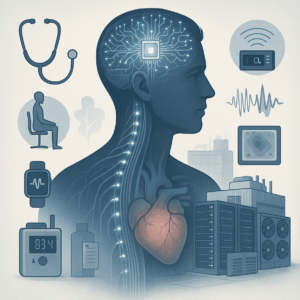
In Occupational Medicine, we are witnessing a “crash test” of our traditional systems. We are no longer just managing clinics; we are managing the “Brain, Heart, and Backbone” of a global workforce. To lead this transformation, we must move beyond viewing AI as a “tech trend” and start viewing it as a fundamental medical evolution.
1. The ‘Brain’: Diagnostics and Predictive Clinical Analytics
The “Brain” of our new system is the ability to process vast amounts of medical data to find patterns invisible to the human eye. NVIDIA’s advancements in Digital Twins of the Human Body mean we no longer have to wait for an injury to occur to understand the risk.
Case Study: Computer Vision in Ergonomics Traditionally, ergonomic assessments were manual and subjective. By implementing NVIDIA-powered computer vision, we can now perform real-time kinetic analysis of workers on a manufacturing floor. AI identifies micro-movements that lead to Musculoskeletal Disorders (MSDs) weeks before a worker feels pain. This shifts the OH physician’s role from “treating a sore back” to “engineering out the risk,” demonstrating a true transformational change agenda.
Predictive Return-to-Work (RTW) Using Microsoft’s Azure AI, we can now cross-reference clinical recovery data with psychosocial “risk markers.” AI models can predict which employees are at high risk of chronic disability based on early interaction patterns, allowing the OH team to intervene with intensified mental health support or workplace adjustments within the first 48 hours of an absence.
2. The ‘Nervous System’: Global Health Surveillance and Environmental Safety
If the Brain makes the decisions, the Nervous System provides the real-time feedback. For a global company, this means moving from “annual check-ups” to “constant awareness.”
Real-Time Toxicology and Noise Monitoring. The next frontier is the integration of wearable biosensors with AI-driven environmental monitoring. In high-risk environments (chemical plants or high-decibel zones), AI acts as a peripheral nervous system, correlating a worker’s physiological stress markers (heart rate variability, sweat cortisol) with real-time exposure levels. At the London AI Tour, Microsoft demonstrated how “Edge Computing” allows this data to be processed locally and privately, ensuring immediate alerts to both the worker and the OH team if “safe thresholds” are breached.
3. The ‘Heart’: Psychological Resilience in a Geopolitical Vacuum
As I observed during the recent “crash test” of regional tensions in the Middle East, the “Heart” of an organization is its collective mental resilience. In times of crisis, the “Duty of Care” must scale faster than humanly possible.
AI-Driven Sentiment and Trauma Support The “trauma of the everyday” in conflict zones is often silent. AI-driven Natural Language Processing (NLP) tools can now monitor anonymized “organizational health sentiment.” By identifying shifts in the collective “tone” of internal communication, leadership can deploy targeted psychological support—such as virtual “resilience hubs”—to specific regions before burnout turns into a crisis. This is “Duty of Care” amplified by intelligence.
4. The ‘Backbone’: Cognitive Ergonomics and the Digital Hygiene Revolution
The skeletal structure—the “Backbone”—of the 2026 workforce is digital. However, this backbone is under immense pressure from “digital overstimulation.” As EHS leaders, we must treat Technostress with the same clinical rigor we treat chemical and other exposures.
The “Right to Disconnect” Algorithms AI is often the cause of “notification fatigue,” but it is also the cure. AI-enabled “Digital Hygiene” assistants can now serve as a shield for the employee’s cognitive bandwidth. By analysing work patterns, AI can automatically “gate” non-essential communications during “deep work” hours or provide “neurological nudges” suggesting a mandatory disconnect period. Our role as medical leaders is to define these “cognitive safe zones” and advocate for them at the C-Suite level.
5. The Ethical Interface: The OHP as the “Human Core”
With NVIDIA’s “Blackwell” architecture and Microsoft’s “Copilots,” the speed of AI is accelerating. This creates a “Black Box” risk—where decisions about employee health are made by algorithms that lack empathy.
This is where the Occupational Physician becomes indispensable. We are the “Ethical and Governance Interface.” We must ensure that AI is used to augment, not automate, human care. Our clinical expertise allows us to audit these AI systems for bias, ensuring that “Predictive Analytics” are never used to discriminate against vulnerable populations, but rather to wrap around them with personalized care.
Conclusion: From Reactive Care to Regenerative Leadership
The momentum I have witnessed at NVIDIA GTC (online) and the Microsoft AI Tour (in-person) and, over the past years confirms that the “old ways” of Occupational Medicine are being disrupted; not dismissed though. But disruption is the “Ray of Hope” we need. The human element/input is necessary. Ultimately, human judgement still prevails; liability is the “Damocles sword”.
We are moving from Reactive Medicine (fixing what is broken) to Regenerative Leadership (building systems that inherently produce health). By integrating the AI “Brain, Heart, and Backbone” into our Duty of Care, we aren’t just protecting the workforce; we are future-proofing the human capital.
For every CEO and EHS leader reading this: The question is no longer if AI will enter your health strategy, but whether you have a medical leader at the helm who knows how to steer it toward a more human future.
“ It was February 2018 when an EHS manager of a construction company contacted me
requesting an occupational medicine perspective, for their data centers’ giga project. That was my very first deep dive into the terms cooling systems, uptime, downtime, coding… the health impact, surveillance framework and the prevention roadmap in the short and long run were the part of my work. Along the way, EU AI Act, GDPR, AI tools and platforms, AI systems sustainability, ESG, Employment Law, environmental prerequisites, natural disaster medicine, H&S standards- national, regional, global- have been part of the learning journey. Does mastery exist anymore? I don’t have an answer for this. I have an answer only as an expert; expertise exists.
As long as humans and AI evolve and develop (AI for sure; for the humans I am a bit reserved…given the current geopolitical landscape; wars and conflicts), including who evolves/develops whom, we keep learning and evolving.
Both, existing and new clients reach out to me to architect their data centers’ occupational health roadmap. Since the stake is of immensely high value for logistics, facilities, environment, equipment and human capital, on-site presence and survey is a non-negotiable. In the AI era it is fair to frame it… a prompt of high quality.
A real-life example? On 28th February, in Dubai, we had a meeting with tech business leaders for the DC occupational health roadmap in the UAE. We had just heard that the war in the Middle East had started before entering the meeting. During the meeting we got notified of the interceptions on the capital of the UAE. It had become more than obvious that in our approach we needed to take into consideration not only the parameter of the natural disasters but also a new parameter that required an additional risk assessment, the human disaster. As we are in the process of navigating this new risk and challenge, we have adjusted the speed of the project whilst monitoring how the situation unfolds… ”